Restoring the Everglades
Restoring the Everglades
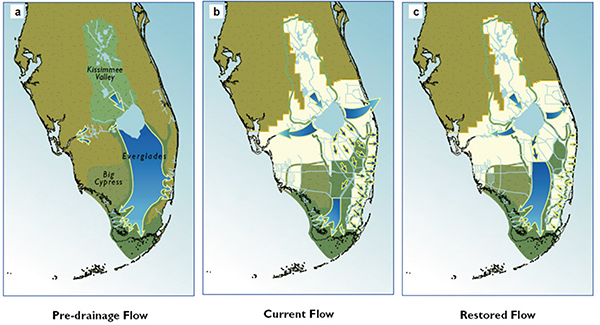
As a society, the state of Florida is fortunately a long way away from the salad days of the early 20th century land boom in South Florida, when Broward County's namesake was elected governor on a promise to drain the Everglades, the vast wetland ecosystem covering large parts of southern Florida, and open the land up for settlement. Such is a task that many have attempted but, in true Florida Man fashion, all have miserably failed at in the long run. That does not mean, however, that the Everglades has taken all the blows inflicted upon it well, nor does it mean that the thousand cuts inflicted upon it have not taken their toll over the years. As the map above indicates, it once covered a much larger portion of the state than it does now, but decades of development and drainage for agriculture and housing have whittled it down to a small fraction of its former area and majesty. Compared to what it once was, it is a malnourished thing vulnerable to rising sea levels, as the quantity of silt and freshwater flowing through is such that it can no longer realistically keep pace with rising sea levels and maintain a stable equilibrium. Given the heavy population density around South Florida, and its dependence upon a healthy Everglades to both prevent flooding and supply freshwater, this is not good news for a city that is already among the most vulnerable in the world to climate change.
Restoring the Everglades has long been the holy grail of Florida environmentalists, and to that effect, in 2000 the federal government created the Comprehensive Everglades Restoration Plan, or CERP, the biggest ecological repair project in history. Recognizing that losing the Everglades would devastate tourism and commercial fishing, along with the jobs associated with such, the CERP envisioned more than sixty construction projects to be built in the Everglades over thirty years, all with the goal of restoring the natural water flow of the "river of grass". These projects included raising the highways that crossed the Everglades so that they no longer functioned as dams, create new stormwater treatment areas to suck phosphorous and other pollutants out of the water as it flowed south, build reservoirs to store water, and reuse wastewater. Projected to cost $7.8 billion, the CERP, it was hoped, would fix the damage done to the Everglades and improve quality of life in the cities of South Florida.
Unfortunately, politics got in the way. Thus far, $6.2 billion has been spent with little to show for it. While the treatment areas were built, the largest artificial wetlands in the world, those are on the periphery of the Everglades, and the money for the big projects has found itself caught in the federal bureaucracy. A lack of federal money has prevented the state of Florida from making progress, with very few projects actually being completed. A follow-up report in 2012 showed that most of the Everglades was still in a sorry state, the ecosystem still deemed "degraded" at best and "near irreversible damage" at worst. Like Duke Nukem Forever, the CERP has become one of those things that's always promised but turns out to underdeliver when the time finally comes around.
Marco Rubio insists that everything is fine. Back in reality, invasive species are running amok in the park, the great elephant in the room that is sea level rise is happening Faster Than Expected (a phrase that's become a cliché in any discussion of climate change), and while phosphorous levels have been brought down from the dangerous levels they were at in the '90s, most objective reports still show a badly degraded ecosystem otherwise. Another $7.4 billion is being requested, pushing the projected cost up to nearly twice what was originally intended.
In other words, amidst the grotesque inefficiency of government in the state of Florida, water is still wet.


Comments
Post a Comment