Choke on it: how dredging hurts coral
Choke on it: how dredging hurts coral
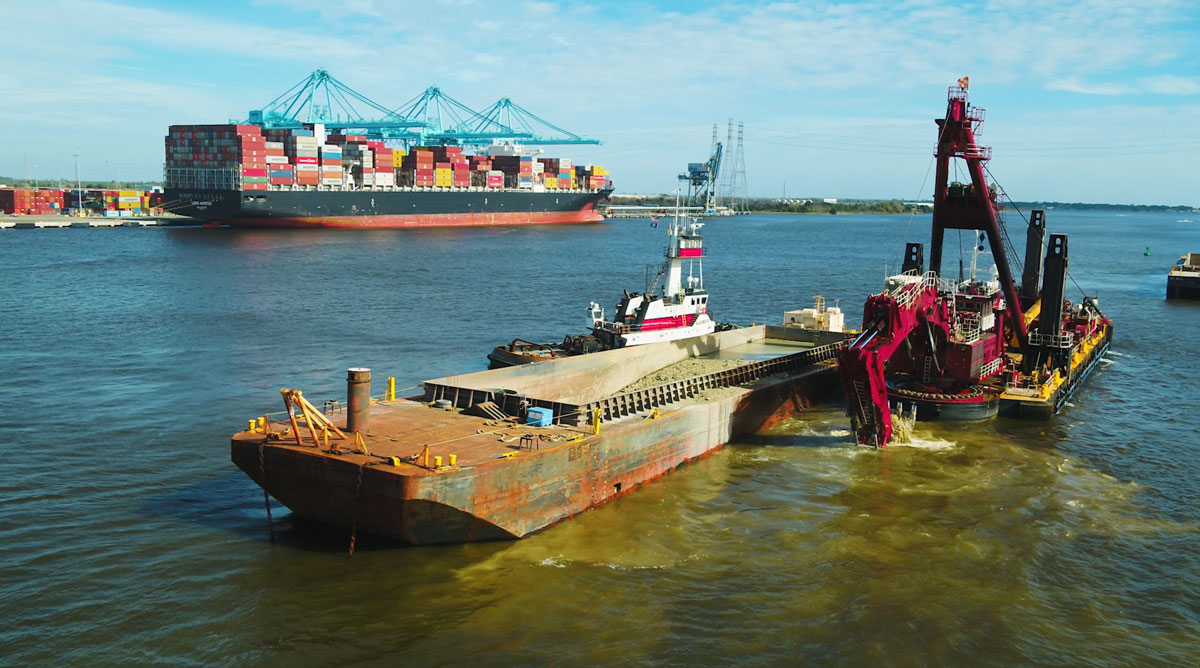
Dredging. South Florida needs it in order to maintain its seaports. The Port of Miami and Port Everglades in Fort Lauderdale are among the largest passenger and container ports in the United States, owing to their proximity to both the Panama Canal and one of America's largest urban areas. They are accessible to large ships because of regular dredging work designed to prevent the accumulation of enough sand and silt to make those ships run aground, without which a key component of the economic engine of South Florida would choke. And as ships grow, ports must be expanded. The recent Deep Dredge Project from 2013 through 2015 at the Port of Miami helped it accommodate the newer, larger freighters traveling through the Panama Canal thanks to a contemporaneous "New Panamax" expansion to such, an important consideration given that the Port of Miami is the closest US seaport to Panama and most of Latin America and the Caribbean, and a similar dredging project is underway at Port Everglades. Furthermore, dredging is also a key component of environmental cleanup in coastal areas, removing contaminated material settled at the bottom of bodies of water. In South Florida, dredging is unavoidable.
There's just one problem, though: what do you do with all that sand?
People who care about coastal ecosystems will be the first to tell you that dredging does nothing good for any coral nearby. A study undertaken in 2019 by Rachel Silverstein, Kelsey Ryan, and Kristen M. Kusek indicated that the Deep Dredge Project was responsible for the deaths of over half a million coral off the coast of Miami, thanks to sediment plumes released from the dredging drifting out to sea and burying entire reefs, literally choking the life out of these vulnerable marine ecosystems. Silverstein, speaking on behalf of the Center for Biological Diversity, warned in 2016 that the Port Everglades project would repeat the problems of the expansion of the Port of Miami. Coral destruction is not merely an academic concern for conservationists; in South Florida, it provides valuable protection for coastal communities. They serve as natural barriers against the waves created by large storms, protecting over $1.6 billion in coastal real estate by mitigating the impact of storm surges. If the coral reefs die, coastal erosion will pick up as waves hit the beaches unmolested.
What to do, then? Dredging the ports and waterways is necessary to support the economy of South Florida, yet the methods being used to perform this vital work are slowly undermining the city's environmental health, leaving it vulnerable to more coastal erosion and impacts to tourism from the death of coral reefs. Fortunately, there are multiple ways to dredge waterways, ranging from mechanical to hydraulic to suction to pneumatic and more. As environmental protection has become a major issue, new, more eco-friendly ways to dredge waterways have emerged, and analysis of the different impacts of different types of dredgers has become a component of various projects. What's more, the capture of sediment kicked up by dredging can even be put to use for beach restoration. Dredging can be done in a cleaner fashion than that which ravaged the reefs off the coast of Miami.
The problem, then, comes down to politics and money. Corner-cutting can bedevil any projects, be they governmental or private enterprise, and nowhere is that more true than in situations where the main "victims" are not humans who can respond with lawyers, but animals and plants. It took a lawsuit by Silverstein to temporarily halt the Port Everglades project until an environmental review of the project could be conducted. Unfortunately, when money is on the line, the advantage usually goes to those in business and government who have more money to start with and a vested interest in running up the score on that front.
In short, Miami seems intent on continuing along a path of self-destructive Florida Man behavior. Today, it's the coral that are paying the price, but the bill always comes due.


Comments
Post a Comment